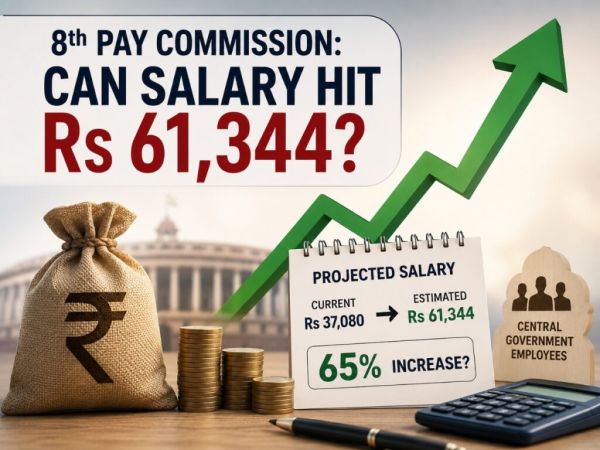
The 8th Pay Commission has once again become a key issue for lakhs of central government employees and pensioners. A salary estimate that has been widely discussed suggests the gross monthly pay of a Level 1 employee could increase from around Rs 37,080 to Rs 61,344 — a jump of nearly 65%.
The estimate is based on proposals submitted by the All India NPS Employees Federation (AINPSEF) to the 8th Central Pay Commission. The federation has recommended a higher fitment factor, a revised House Rent Allowance (HRA), a minimum Transport Allowance (TA) of Rs 9,000 a month for Level 1 employees and changes to the family unit formula used to determine minimum pay.
However, there is one important point that employees should note. This is only an indicative projection and not an approved salary revision. The government has not accepted these proposals and the 8th Pay Commission is still holding consultations with employee organisations, unions and other stakeholders before finalising its recommendations.
So how do we arrive at a Rs 61,344 projected salary? Here’s the short answer.
What Is The Rationale For Discussing The 65% Salary Hike?
Many employees tend to focus only on the fitment factor when estimating how much their salary could increase under the 8th Pay Commission. But employee organisations say the overall revision should go beyond just the basic pay.
Their recommendations include:
A higher fitment factor
Changes to the family unit formula used for minimum pay calculation
Higher House Rent Allowance (HRA)
Increased Transport Allowance (TA)
Merger of Dearness Allowance (DA) with basic pay
Better protection against rising inflation
If several of these proposals are accepted together, the overall increase in gross salary could be much larger than what a higher basic pay alone would deliver.
How The Fitment Factor Can Increase Basic Pay
The fitment factor is the number that is used to change an employee’s current base pay.
For example, if the basic pay of a Level 1 employee is Rs 18,000 and a fitment factor of 2.10 is applied, the revised basic pay will be as follows:
Rs 18,000 x 2.1 = Rs 37,800
Note that 2.10 is an assumed figure, used for illustrative purposes only. The actual fitment factor would be known only after the Pay Commission submits its recommendations and the government takes a final decision.
Why Has the Family Unit Formula Become Part of the Discussion?
Another proposal is linked to the formula of the family unit, which is applied in calculating minimum wages.
Employee representatives said that the present formula does not reflect the costs of households today. They have proposed increasing the family unit from 3 to 4.4 units to include dependent parents.
They say the change would present a more realistic picture of the cost of food, housing, healthcare and other essential household needs. If accepted, it could influence the calculation of minimum pay and, indirectly, the fitment factor.
Why HRA Could Make A Big Difference
House Rent Allowance is calculated as a percentage of basic pay. So, when the basic salary increases, HRA also goes up automatically.
At present, HRA is payable at 30%, 20% and 10% of basic pay to the employees posted in X, Y & Z cities, respectively. AINPSEF has recommended increasing these rates to 36%, 24% and 12% under the 8th Pay Commission.
Employees posted in metro cities say housing costs have increased sharply over the years. A higher basic pay along with a higher HRA rate could therefore add significantly to monthly earnings.
The Transport Allowance May Also Go Up
With fuel prices going up and public transport costs rising, travelling to work has become more expensive.
To address these issues, employee organisations have demanded that the minimum transport allowance for Level 1 employees be increased to Rs 9,000 per month.
Unlike HRA, a higher transport allowance will directly add to the monthly income and can make a huge difference to the gross salary.
Why Is There A Call To Combine DA With Basic Pay?
The DA is passed on to employees to absorb the inflation and is revised from time to time.
Employee unions have argued that DA should be merged with basic pay before the new pay structure is implemented.
The reason is simple. Several salary components—including HRA and certain retirement- benefits—link to basic pay. If DA becomes part of the basic salary, the calculations will use a higher base, which could increase overall benefits.
However, there is no official confirmation that the government will accept this proposal.
How Is The Rs 61,344 Salary Estimate Calculated?
The widely discussed 65% salary hike is based on an illustrative scenario prepared using the proposals made by employee organisations. It should not be treated as the government’s salary estimate.
What Does This Projection Mean?
From this example:
Gross monthly salary at present: Rs 37,080
Average gross monthly salary: Rs 61,344
Rs 24,264 monthly increase
65.4% or more expected salary hike
Estimated annual increment: Rs 2.91 lakh approx
The implementation of the proposed fitment factor, revised HRA, higher Transport Allowance, and the assumed treatment of Dearness Allowance in combination may increase the gross monthly salary of a Level 1 employee by almost 65%.
Again, this figure is just a projection based on multiple assumptions and not a confirmed salary revision.
Is 65% Salary Hike Confirmed?
No. The increase is expected based on recommendations from employee organisations such as AINPSEF. There is no announcement of a 65% salary hike by the 8th Pay Commission or Central Government.
There are several factors that will determine the final revised version:
The fitment factor proposed by the Commission
New pay matrix
HRA rates revised
Transportation Allowance
Merger of Dearness Allowance with basic pay
Final approval of the Central Government
What To Watch Next For The Central Government Employee?
The 8th Pay Commission is likely to consider suggestions from employee organisations and others before submitting its report to the government.
The key announcements from central government employees are the fitment factor, revised minimum pay, changes in HRA and transport allowance, treatment of dearness allowance and implementation timeline.
The projected 65% increase has generated enough discussion but it should be seen as a potential scenario and not as a guaranteed salary hike. The actual salary structure will be known only after the recommendations of the 8th Pay Commission are submitted and the final decision is taken by the central government.
Priyanka Roshan is a business writer and assistant editor at the NewsX website who tracks everything from stock market swings and corporate earnings to personal finance trends and policy shifts. Known for turning fast-moving business developments into sharp, reader-friendly stories, she combines speed, accuracy, and a data-driven approach to break down complex financial news for everyday audiences.
With over 9.5 years of newsroom experience, Priyanka has worked with leading media organisations, including Bussiness, Times Now, and Ping Digital, covering diverse beats such as business, politics, technology, auto, travel, sports, and the world. From live breaking news desks to SEO-led digital storytelling, she specialises in creating engaging content that keeps readers informed without overwhelming them.
The post 8th Pay Commission: Can Higher HRA, TA and DA Push Salary to Rs 61,344? Here’s the Math appeared first on NewsX.
Contact to : xlf550402@gmail.com
Copyright © boyuanhulian 2020 - 2023. All Right Reserved.