The bottle of perfume you reach for every morning may feel simple, just a quick spray before leaving the house. But behind that scent is a process most people rarely think about.
For perfumers, creating fragrance begins long before a scent ever reaches a bottle. Many avoid wearing perfume to the office so it does not interfere with their sense of smell. Their work depends on precision, patience, and an unusual skill, the ability to imagine aromas before they even exist.
“A perfumer can imagine the smell before actually smelling it,” says Julia Rodríguez, Senior Perfumer at Eurofragance, a family-owned fragrance house headquartered in Barcelona, with a presence in 70 countries, including Dubai, where she is now based.
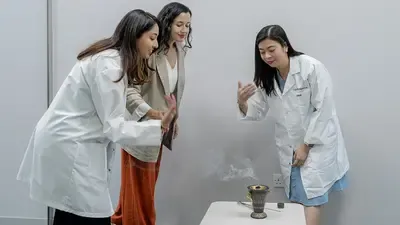
Julia Rodríguez in the middle at Eurofragance
Like a musician who hears notes in their mind or a chef who anticipates the taste of a dish before cooking it, Rodríguez builds fragrances mentally first. The process, she explained, is less about mixing bottles in a lab and more about composing formulas, testing them, and refining them repeatedly until the idea becomes a scent.
“Once you study hundreds of raw materials, they stay in your mind,” she told Khaleej Times . “You can imagine how they will smell together before the formula is even made.”
Originally from Barcelona, Rodríguez has spent the past 17 years working in perfumery. Over the last decade, much of her focus has been on the Middle East, a region she said continue to shape the global fragrance industry.
From childhood curiosity to perfumeryRodríguez’s connection to fragrance began early. As a child, she was fascinated by the smells around her, partly influenced by her father, who worked in the perfume industry.
“He used to tell me stories about raw materials and how fragrances are built,” she recalled.
Still, perfumery was not always the career she imagined. Growing up, she considered becoming many things, a doctor, photographer, musician, or scientist.
Eventually, she realized perfumery combined many of those interests.
“It is storytelling with a scientific background,” she said. “You are playing with emotions. You can make someone feel happier, more confident or more comfortable through scent.”
Art meets scienceDespite the romantic image people often associate with perfumers, Rodríguez said fragrance creation is both artistic and technical.
The process begins with studying and selecting raw materials, sometimes hundreds of them, and learning how they interact with each other. Over time, perfumers build a mental library of scents they can combine in their mind before testing them.
“Once you study many raw materials, they stay in your mind,” she said. “You can imagine how they will smell together.”
Technology comes later in the process. Perfumers use computers to write and refine formulas before sending them to the laboratory, where the fragrance is produced and evaluated.
Sometimes the result matches what she imagined. Other times it takes multiple rounds of adjustments.
“Some projects are fast. Others take a lot of time,” she said. “You need patience.”
Creating for someone elseOne of the biggest challenges in perfumery, Rodríguez explained, is that perfumers rarely create for themselves.
“We don’t work for what we personally want,” she said. “We work for a client. It is a collaboration.”
For Rodríguez, working with Middle Eastern clients adds another layer of creativity.
“It is more interesting to work in this region,” she says. “Clients are very knowledgeable about fragrance. Perfume is part of the culture and part of daily life.”
Unlike many Western markets, where perfumers often present ideas to marketing teams, she says meetings in the region frequently involve brand founders or owners who are deeply passionate about scent.
“They know a lot about perfumery,” she said. “Sometimes they know even more about certain ingredients than you expect.”
A region shaping global fragranceAccording to Rodríguez, the influence of Middle Eastern perfumery is now being felt worldwide.
Fragrances inspired by the region, particularly those featuring notes such as incense, amber, and oud, are increasingly popular across Europe, the United States, and Latin America.
“The whole world is looking at this region,” she said. Among Rodríguez’s personal favorites is incense, known locally as luban. “I love incense,” she said. “It has something mystical.”
Capturing Dubai in a fragranceIf she had to translate Dubai into a fragrance, Rodríguez already knows how she would build it.
“I would use a lot of ambergris and incense,” she said. “Then modern fruity notes on top, maybe mango or passion fruit, and touches of rose and oud.”
The combination, she said, reflects the city’s identity. “Something between modern and tradition.”
Ajmal Perfumes rebrands as Ajmal Dubai, celebrating the scent of a city How AI turns horror scenes into viral 'nightmare fragrance'Contact to : xlf550402@gmail.com
Copyright © boyuanhulian 2020 - 2023. All Right Reserved.