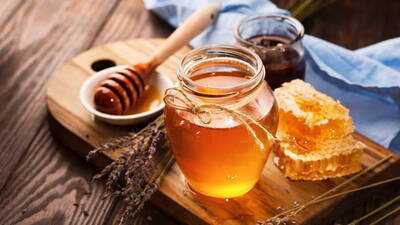
Honey is a natural sweetener that also works as a detoxifying and cleaning agent for the human body. From Ayurveda to nutritionists, everyone swears by honey as a natural and healthy alternative to white sugar. But, in present market conditions, even honey is not safe any more. In a major crackdown recently, Food Safety and Standards Authority of India (FSSAI) officials seized 15,000 kg of suspected adulterated honey during an enforcement drive in Hapur, UP. Scroll down to read the details.
According to an X post, shared by FSSAI, samples from the seized stock worth Rs 22 lakh have been collected and sent for laboratory testing to check whether the honey meets food safety standards. Officials are yet to share the final test results, but the incident highlights the ongoing concern around adulterated food products entering the market. FSSAI wrote, “#UttarPradesh #Hapur The Uttar Pradesh Food Safety Department has seized 15,000 kg of adulterated honey from Hapur. Samples of honey worth about 22 lakh rupees were taken for testing.”
How does FSSAI define honey
According to an FSSAI document, Codex defines honey as a natural sweet product produced by bees from the nectar plants (blossom honey) or from secretions of living parts of plants or secretions of insects (honeydew honey) that bees collect, deposit, dehydrate, store and leave in the honeycomb to ripen and mature.
FSSAI's honey standards
Based on the approval of Food Authority on the method of detection of 2-Acetylfuran-3-Glucopyranoside (2- AFGP)/3-0-Alpha-D-Glucosyl Isomaltol, the specific marker for Rice Syrup (SMR), LC-MS the parameter specific marker for Rice Syrup (SMR) was reinstated through a notification dated 5 June 2020.
Common adulterants used in honey
The most common adulterants used in honey to meet the demand are sugar syrup, High Fructose Corn Syrup (HFCS), rice syrup, invert sugar syrup, molasses, jaggery syrup, starch or flour, artificial flavours and colours, and glucose syrup.
How to check purity of honey at home 
Water test: According to FSSAI, for this test, you need to take a glass of room-temperature water and drop in a teaspoon of honey. Pure honey sinks straight to the bottom without dissolving right away. While adulterated honey starts to spread or dissolve quickly. Also, swirl the glass gently, if it dissolves too easily, that jar’s been tampered with adulterants.
Flame test: Take a dry cotton wick or matchstick, dip it into the honey jar and try lighting it. Pure honey will allow the wick to burn steadily. On the other hand, fake honey often contains added water or sugar syrups that make the wick too damp to ignite.
Blot test: Take a piece of plain white tissue or blotting paper and drop a small amount of honey on it. Pure honey will stay thick and not soak through. While adulterated honey will seep into the paper quickly, leaving a wet mark, which indicates the presence of added water or syrups.
Fridge test: This is a very popular method, where you simply store the honey jar in the fridge. The adulterated ones often crystallise unevenly or separate into layers, while the pure honey thickens but stays consistent in texture.
How to buy pure honey
According to FSSAI, it is important for buyers to read the labels that say “raw,” “unprocessed,” or “single-origin,” but don’t rely only on words. It is important to look for certified brands that test for C3/C4 sugar adulteration (via lab reports or QR codes). Also, look for the FSSAI license and batch number and check it online on the FSSAI website for more clarity. Also, honey with an ‘untypical’ 1H-NMR profile is automatically considered non-authentic or adulterated.
Images Courtesy: istock and X
Contact to : xlf550402@gmail.com
Copyright © boyuanhulian 2020 - 2023. All Right Reserved.