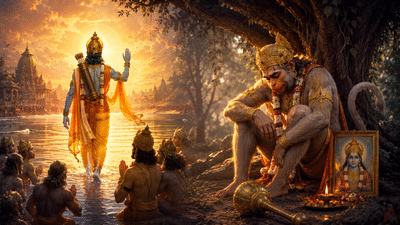
Why Hanuman Stayed Alive While Lord Ram Left Earth
Among the countless emotional mysteries hidden within the Ramayana, few questions move devotees as deeply as the fate of Lord Hanuman after Lord Ram departed from Earth. When Shri Ram completed his divine mission and returned to his eternal abode, many close companions also left the mortal world. Ayodhya itself entered an atmosphere of divine separation and spiritual sorrow. Yet one being remained. Hanuman Ji did not leave Earth. The greatest devotee of Lord Ram stayed behind while his beloved Lord departed.
For centuries, devotees have wondered why Hanuman continued to remain in this world despite having complete freedom to follow Ram into the divine realm. The answer lies within one of the most beautiful truths of Sanatana Dharma: Hanuman was not born merely to witness Ram’s incarnation. He was born to keep Ram’s presence alive on Earth forever. This is why Hindu tradition reveres Hanuman not only as a mighty warrior or divine servant, but also as the eternal guardian of devotion itself.
The Emotional Final Moments of Lord Ram’s Earthly Journey

According to the Uttara Kanda of the Ramayana and later devotional traditions, Lord Ram eventually completed the purpose of his incarnation on Earth. After establishing dharma, ruling Ayodhya with justice, and fulfilling his divine mission, the time came for his earthly departure. The atmosphere during Ram’s final moments is described as emotionally overwhelming. Devotees, citizens, and companions could not imagine a world without Ram’s presence. Ayodhya itself seemed to lose its light.
Many companions of Ram followed him toward the Sarayu River, where he prepared to leave his earthly form and return to his eternal divine nature as Lord Vishnu. But Hanuman did not go. The greatest devotee remained behind. This moment became one of the most spiritually powerful mysteries in Hindu tradition.
Hanuman Did Not Want Liberation Without Ram’s Name Remaining on Earth

One of the deepest reasons given in devotional traditions is that Hanuman’s love for Lord Ram was greater than his desire for liberation itself. In Hindu philosophy, moksha or liberation is considered the ultimate spiritual goal. Yet Hanuman is repeatedly portrayed as a devotee who did not seek liberation, heaven, power, or personal reward. His only desire was eternal service to Ram. Many devotional texts and traditions describe Hanuman praying that he should remain alive wherever Lord Ram’s name is remembered, sung, or worshipped.
This belief became central to Hanuman bhakti across India. According to popular tradition, Lord Ram granted Hanuman the blessing of remaining on Earth for as long as Ram’s story and name continue to exist among humanity. This transformed Hanuman into a Chiranjeevi, an immortal being destined to remain present through the ages.
Hanuman Became the Eternal Protector of Ram Bhakti
Hanuman’s continued presence on Earth carries profound spiritual meaning. While Lord Ram’s earthly incarnation eventually concluded, devotion to Ram was never meant to disappear. Hanuman became the eternal bridge between devotees and Ram himself. This is why many Hindu traditions believe Hanuman is still spiritually present wherever:
The Beautiful Conversation Between Ram and Hanuman
Several devotional retellings describe deeply emotional exchanges between Lord Ram and Hanuman before Ram’s departure. According to traditional beliefs, Ram offered Hanuman the opportunity to accompany him to the divine realm. But Hanuman chose something extraordinary. He chose to remain wherever Ram’s devotees existed. For Hanuman, serving devotees of Ram became equal to serving Ram himself. This decision reveals the unmatched depth of Hanuman’s devotion. Unlike many beings who seek liberation from earthly existence, Hanuman willingly remained in the mortal world out of pure love and service. This is why Hanuman is often considered the greatest example of selfless bhakti in Hindu tradition.
Why Hanuman Is Called the Greatest Devotee in Hinduism
The spiritual greatness of Hanuman lies not merely in his power, but in his complete surrender to Lord Ram. Hanuman could lift mountains, destroy armies, cross oceans, and terrify demons. Yet despite possessing unimaginable strength, he never desired kingship, fame, or worship for himself. Everything he did was for Ram. Even after Ram departed from Earth, Hanuman’s identity remained unchanged. He continued living only to spread Ram’s glory and protect Ram devotees. This level of devotion is considered extraordinarily rare in Hindu philosophy.
Many saints and spiritual teachers across centuries have described Hanuman as the highest embodiment of:
The Loneliness of Hanuman After Ram’s Departure
One of the most emotionally haunting images in devotional imagination is Hanuman remaining on Earth after Ram’s departure. Imagine the silence of Ayodhya after Ram leaves. The palace corridors once filled with divine presence now stand empty. The king whom Hanuman worshipped with every breath is no longer physically present before him. Yet Hanuman continues. Not out of attachment to the world, but out of commitment to Ram’s mission. For devotees, this image carries extraordinary emotional power. Hanuman becomes the eternal witness of Ram’s story across generations. This is one reason why Hanuman devotion often feels deeply emotional and personal compared to many other forms of worship.
Why Devotees Believe Hanuman Still Walks the Earth
The belief that Hanuman still exists spiritually on Earth remains widespread across Hindu traditions. Many stories, legends, saints, and devotional experiences describe Hanuman appearing in mysterious forms to protect sincere devotees during moments of danger, fear, or intense prayer.
Temples dedicated to Hanuman are among the most visited in India because devotees view him as:
Hanuman’s Immortality Symbolizes Eternal Devotion
Spiritually, Hanuman’s immortality carries symbolic meaning beyond physical existence.
As long as:
Conclusion: Hanuman Stayed Because Love Never Left
Hanuman stayed alive while Lord Ram left Earth because his devotion was greater than any desire for liberation or divine reward. Lord Ram’s earthly incarnation may have concluded, but the mission of preserving Ram bhakti among humanity continued through Hanuman. This is why Hindu tradition reveres Hanuman not merely as a warrior of the Ramayana, but as the eternal servant of dharma and protector of devotees across all ages. For millions of devotees, the idea that Hanuman still spiritually walks the Earth brings immense comfort and faith.
Because according to one of the most beautiful beliefs in Hindu tradition, wherever Ram’s name is remembered with sincerity, Hanuman is never far away.
Unlock insightful tips and inspiration on personal growth, productivity, and well-being. Stay motivated and updated with the latest at My Life XP.
For centuries, devotees have wondered why Hanuman continued to remain in this world despite having complete freedom to follow Ram into the divine realm. The answer lies within one of the most beautiful truths of Sanatana Dharma: Hanuman was not born merely to witness Ram’s incarnation. He was born to keep Ram’s presence alive on Earth forever. This is why Hindu tradition reveres Hanuman not only as a mighty warrior or divine servant, but also as the eternal guardian of devotion itself.
The Emotional Final Moments of Lord Ram’s Earthly Journey
According to the Uttara Kanda of the Ramayana and later devotional traditions, Lord Ram eventually completed the purpose of his incarnation on Earth. After establishing dharma, ruling Ayodhya with justice, and fulfilling his divine mission, the time came for his earthly departure. The atmosphere during Ram’s final moments is described as emotionally overwhelming. Devotees, citizens, and companions could not imagine a world without Ram’s presence. Ayodhya itself seemed to lose its light.
Many companions of Ram followed him toward the Sarayu River, where he prepared to leave his earthly form and return to his eternal divine nature as Lord Vishnu. But Hanuman did not go. The greatest devotee remained behind. This moment became one of the most spiritually powerful mysteries in Hindu tradition.
Hanuman Did Not Want Liberation Without Ram’s Name Remaining on Earth
One of the deepest reasons given in devotional traditions is that Hanuman’s love for Lord Ram was greater than his desire for liberation itself. In Hindu philosophy, moksha or liberation is considered the ultimate spiritual goal. Yet Hanuman is repeatedly portrayed as a devotee who did not seek liberation, heaven, power, or personal reward. His only desire was eternal service to Ram. Many devotional texts and traditions describe Hanuman praying that he should remain alive wherever Lord Ram’s name is remembered, sung, or worshipped.
This belief became central to Hanuman bhakti across India. According to popular tradition, Lord Ram granted Hanuman the blessing of remaining on Earth for as long as Ram’s story and name continue to exist among humanity. This transformed Hanuman into a Chiranjeevi, an immortal being destined to remain present through the ages.
Hanuman Became the Eternal Protector of Ram Bhakti
Hanuman’s continued presence on Earth carries profound spiritual meaning. While Lord Ram’s earthly incarnation eventually concluded, devotion to Ram was never meant to disappear. Hanuman became the eternal bridge between devotees and Ram himself. This is why many Hindu traditions believe Hanuman is still spiritually present wherever:
- Ramayana is recited
- Ram Naam is chanted
- sincere devotion exists
- bhajans praising Ram are sung
The Beautiful Conversation Between Ram and Hanuman
Several devotional retellings describe deeply emotional exchanges between Lord Ram and Hanuman before Ram’s departure. According to traditional beliefs, Ram offered Hanuman the opportunity to accompany him to the divine realm. But Hanuman chose something extraordinary. He chose to remain wherever Ram’s devotees existed. For Hanuman, serving devotees of Ram became equal to serving Ram himself. This decision reveals the unmatched depth of Hanuman’s devotion. Unlike many beings who seek liberation from earthly existence, Hanuman willingly remained in the mortal world out of pure love and service. This is why Hanuman is often considered the greatest example of selfless bhakti in Hindu tradition.
Why Hanuman Is Called the Greatest Devotee in Hinduism
The spiritual greatness of Hanuman lies not merely in his power, but in his complete surrender to Lord Ram. Hanuman could lift mountains, destroy armies, cross oceans, and terrify demons. Yet despite possessing unimaginable strength, he never desired kingship, fame, or worship for himself. Everything he did was for Ram. Even after Ram departed from Earth, Hanuman’s identity remained unchanged. He continued living only to spread Ram’s glory and protect Ram devotees. This level of devotion is considered extraordinarily rare in Hindu philosophy.
Many saints and spiritual teachers across centuries have described Hanuman as the highest embodiment of:
- humility
- surrender
- loyalty
- courage
- selfless devotion
The Loneliness of Hanuman After Ram’s Departure
One of the most emotionally haunting images in devotional imagination is Hanuman remaining on Earth after Ram’s departure. Imagine the silence of Ayodhya after Ram leaves. The palace corridors once filled with divine presence now stand empty. The king whom Hanuman worshipped with every breath is no longer physically present before him. Yet Hanuman continues. Not out of attachment to the world, but out of commitment to Ram’s mission. For devotees, this image carries extraordinary emotional power. Hanuman becomes the eternal witness of Ram’s story across generations. This is one reason why Hanuman devotion often feels deeply emotional and personal compared to many other forms of worship.
Why Devotees Believe Hanuman Still Walks the Earth
The belief that Hanuman still exists spiritually on Earth remains widespread across Hindu traditions. Many stories, legends, saints, and devotional experiences describe Hanuman appearing in mysterious forms to protect sincere devotees during moments of danger, fear, or intense prayer.
Temples dedicated to Hanuman are among the most visited in India because devotees view him as:
- immediately accessible
- compassionate
- protective
- actively present
Hanuman’s Immortality Symbolizes Eternal Devotion
Spiritually, Hanuman’s immortality carries symbolic meaning beyond physical existence.
As long as:
- Ram’s name survives
- dharma survives
- devotion survives
- righteousness survives
Conclusion: Hanuman Stayed Because Love Never Left
Hanuman stayed alive while Lord Ram left Earth because his devotion was greater than any desire for liberation or divine reward. Lord Ram’s earthly incarnation may have concluded, but the mission of preserving Ram bhakti among humanity continued through Hanuman. This is why Hindu tradition reveres Hanuman not merely as a warrior of the Ramayana, but as the eternal servant of dharma and protector of devotees across all ages. For millions of devotees, the idea that Hanuman still spiritually walks the Earth brings immense comfort and faith.
Because according to one of the most beautiful beliefs in Hindu tradition, wherever Ram’s name is remembered with sincerity, Hanuman is never far away.
Unlock insightful tips and inspiration on personal growth, productivity, and well-being. Stay motivated and updated with the latest at My Life XP.
Contact to : xlf550402@gmail.com
Copyright © boyuanhulian 2020 - 2023. All Right Reserved.