
Digital banking reshapes workforce demand
When Hoang Anh graduated in finance and banking in 2022, many of her classmates pursued conventional banking roles such as customer relations, credit advisory, and teller services. She chose a different path, joining the risk management department of a commercial bank — an area that has become increasingly important as digital banking expands.
By 2024-2025, while many routine banking transactions had shifted to mobile applications, Hoang Anh’s department continued to grow. Her work now focuses on analyzing credit data, monitoring unusual transaction patterns, and issuing early risk warnings rather than direct customer interaction.
“When I was at university, I never imagined this would become a career path with so many opportunities,” Hoang Anh said. “Only after entering the industry did I realize that much of what keeps a bank running happens behind the scenes — data, risk management, and operational controls.”
Her experience reflects broader changes taking place across the banking and finance sector. Transactions such as money transfers, savings deposits, account opening, card applications, bill payments, and consumer loan registrations can now be completed through smartphones within minutes, reducing the need for traditional in-person services.
However, the decline of branch-based operations has not reduced demand for banking professionals. As more transactions move online, the complexity of underlying systems continues to increase, particularly in areas such as risk monitoring, fraud detection, anti-money laundering, compliance, customer data analysis, and treasury management.
Students consider which major to choose to avoid falling behind after four years at university. Photo courtesy of BUV |
Career opportunities amid industry transformation
According to Banking Review, Vietnam’s interbank electronic payment system — often described as the backbone of the country’s payment infrastructure — processed an average of nearly 589,000 transactions per day in 2025, with a total transaction value exceeding VND1.61 quadrillion (US$61.1 billion). Transaction value increased 56.55% year-on-year.
Many banks have also reported that around 98% of customer transactions are now conducted through digital channels.
Banks are increasingly functioning not only as service providers but also as part of the infrastructure supporting the circulation of capital throughout the economy. As these systems become faster and more automated, the need for oversight and risk control has also grown.
As a result, roles involving risk management, compliance, anti-money laundering, internal audit, financial data analysis, treasury management, and investment analysis are receiving greater attention. Although these are typically non-customer-facing positions, they play an important role in maintaining the stability and security of financial systems.
Recruitment trends reflect this shift. ManpowerGroup Vietnam has identified finance and banking as sectors with strong hiring demand, driven by digital transformation, artificial intelligence, and automation. The company noted rising recruitment needs for digital banking, risk management, and compliance roles.
Robert Walters has also reported difficulties among employers in finding candidates who can combine financial knowledge with data analysis, digital skills, and regulatory understanding.
Rather than shrinking, the finance and banking labor market is becoming more specialized. Positions centered on repetitive operational work are facing increasing pressure from automation, while roles requiring analytical thinking, regulatory expertise, and data-driven decision-making continue to offer stronger long-term prospects.
As a result, finance and banking degrees are increasingly viewed as pathways not only to traditional banking roles but also to careers in fintech, investment management, financial analysis, corporate advisory, compliance, risk management, and corporate finance.
Education and industry requirements
As industry expectations evolve, the choice of academic program is becoming more significant.
Programs that combine international finance standards with practical understanding of Vietnam’s market are attracting growing interest by allowing students to gain global knowledge while remaining connected to domestic industry realities.
British University Vietnam’s BSc (Hons) Banking and Finance program is designed around this approach.
The program is delivered in partnership with Manchester Metropolitan University, a public university in the U.K. with a history spanning more than 200 years. Its business school holds triple accreditation from AACSB, AMBA, and EQUIS, placing it among the world’s top 1% of business schools according to accreditation organizations.
Graduates receive degrees awarded by both Manchester Metropolitan University and British University Vietnam (BUV), combining international and domestic academic recognition.
One feature of the program is student access to Bloomberg Terminal systems, which are widely used in financial institutions globally. The platform enables students to work with real-time market data and gain exposure to professional financial analysis environments.
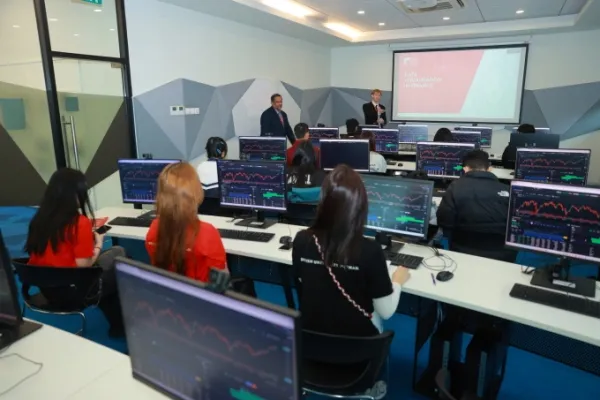 |
Students learn financial data analysis at British University Vietnam’s Finance Lab. Photo courtesy of BUV |
The program also introduces students to international banking standards such as Basel II and Basel III, frameworks increasingly applied by banks operating in Vietnam.
Rather than focusing primarily on traditional front-office banking roles, the program is designed to prepare students for careers in financial analysis, risk management, compliance monitoring, and corporate financial advisory, areas expected to maintain long-term demand despite growing automation.
Graduates may also qualify for exemptions from selected professional examinations offered by international organizations including ACCA, CIMA, ICAEW, and CII, supporting students pursuing careers in finance, accounting, management, and insurance.
Students receive direct guidance from lecturers. Photo courtesy of BUV |
Students also have opportunities to connect with domestic and international banks and financial institutions through internships and industry engagement during their studies.
With the cost of studying in the U.K. often exceeding US$114,000 for three years, internationally recognized programs based in Vietnam are increasingly viewed as a more cost-effective alternative. The program is currently offering scholarships for its first intake.
British University Vietnam is the first university in Vietnam to receive a five-star QS rating and the first university in Vietnam and ASEAN accredited by the U.K.’s Quality Assurance Agency for Higher Education (QAA). According to the university, its programs are regularly updated to reflect industry developments and emphasize the integration of academic learning with practical application. The university said all graduates either secure employment or continue further study within three months of graduation.
Learn more about the program here.
Contact to : xlf550402@gmail.com
Copyright © boyuanhulian 2020 - 2023. All Right Reserved.