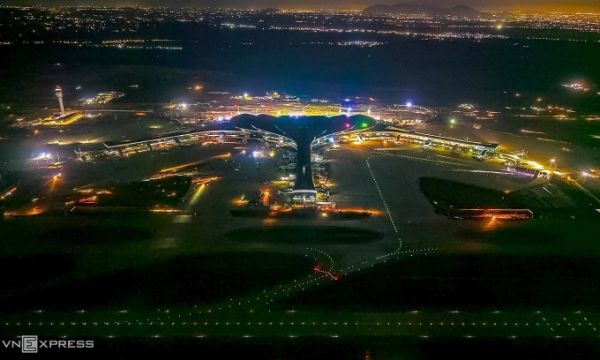
The airport’s project management board said on June 10 it had energized the power system together with the Dong Nai Power Company, feeding electricity from a dedicated 110 kV substation into the receiving station run by Airports Corporation of Vietnam (ACV), the state-owned developer building the airport about 40 km east of Ho Chi Minh City.
Stable, continuous power is a prerequisite for what comes next: a series of trial runs that will test the terminal, baggage systems and ground operations before passengers arrive. ACV plans three rounds of trial operations in September, October and November, with official commercial service targeted for December 2026.
Long Thanh airport’s power supply is officially switched on, June 2026. Photo by Read/Thai Ha |
The milestone caps a frantic stretch of construction. On June 1, ACV launched a 180-day sprint to finish the airport on time, a push that follows years in which the project wrestled with labor shortages, contractor payment delays and volatile material prices. Roughly 76% of the total project by value is now complete, and the most critical pieces are further along. The aircraft apron near the terminal is more than 88% finished, the fuel system more than 92%, and the connecting roads close to 90%. The passenger terminal, the centerpiece, has its main structure up and is about two-thirds of the way through interior work and equipment installation.
The airfield itself is already operational. Long Thanh’s first runway and apron are complete, and the runway received its first calibration flight in September 2025. In December, a Vietnam Airlines Boeing 787 made the first technical landing, followed days later by the first official flight, both treated as symbolic markers of how close the long-delayed project had come.
Power for the site runs through a substation the Dong Nai Power Company inaugurated on Dec. 16, 2025, built for more than VND158 billion ($6 million). It carries two transformers with a combined capacity of 80 MVA and feeds the airport through six separate 22 kV lines, enough to cover a construction site that already consumes about 730,000 kWh a month and will draw far more once systems are powered up for testing. The station is designed to run unmanned, monitored remotely.
Long Thanh is one of Vietnam’s most ambitious infrastructure bets. Spread across roughly 5,000 hectares, the first phase will handle 25 million passengers and 1.2 million tons of cargo a year. Later phases are designed to lift capacity to as much as 100 million passengers annually, which would make it the country’s largest airport by a wide margin and, ACV hopes, a regional transit hub able to compete with the established gateways in Singapore, Bangkok and Kuala Lumpur.
Tan Son Nhat, the airport currently serving Ho Chi Minh City, has been operating well beyond its designed capacity for years, and Long Thanh is meant to absorb the overflow and reclaim long-haul traffic that now connects through neighboring hubs.
Contact to : xlf550402@gmail.com
Copyright © boyuanhulian 2020 - 2023. All Right Reserved.