5 Major Challenges Facing E100 Fuel: Amidst the ongoing tension in the Middle East, rising crude oil prices have increased the concern of the entire world. Meanwhile, India has taken a big step towards alternative and clean fuel of petrol. Union Road and Transport Minister Nitin Gadkari has approved the rules for E100 fuel (100% ethanol), paving the way for vehicles running on 100 percent ethanol. This announcement marks an important milestone in India’s biofuel mission and could reshape the future of mobility in the country.
During an event in Nagpur, Maharashtra, Nitin Gadkari said that he had signed the rules approving the use of E100 fuel on June 12. Now that the new framework has been implemented, car manufacturers, fuel retailers and testing agencies can start preparing for the commercial rollout of ethanol-powered vehicles.
Government’s step after the success of E20
The move builds on the success of India’s E20 (20% ethanol) programme, which had achieved 20 per cent ethanol blending ahead of schedule by April 2026. According to the government, the ethanol initiative has already helped save over Rs 1 lakh crore in crude oil imports, while generating income of about Rs 80,000 crore for farmers. One of the biggest highlights of this announcement was the launch of the E100-compatible Maruti Suzuki WagonR. Maruti Suzuki WagonR has become one of the first mass-market cars in India capable of running on 100 percent ethanol.
Nitin Gadkari said that he Petroleum Minister Hardeep Singh Puri Launched an ethanol-compatible version of Maruti Suzuki WagonR in collaboration with Maruti Suzuki WagonR. As India’s best-selling hatchback, the Maruti Suzuki WagonR could play a key role in popularizing flex-fuel technology among Indian buyers.
Many challenges before 100% ethanol
100 percent ethanol has been approved by the government, but it is quite challenging to implement this change on the ground. The biggest hurdle is to make technological changes in the existing petrol pumps, as the nature of ethanol is different from petrol which requires special storage and pipeline infrastructure. Additionally, existing automobile engines are not capable of running on 100% ethanol, necessitating the widespread introduction of flex-fuel engines. Maintaining the supply chain and continuous production of ethanol is also a big challenge before the government, without solving which it is difficult to get the comprehensive benefits of this scheme. Let us understand those 5 big challenges in detail through this explainer.
1. Technical changes in petrol pumps
In a country like India, the biggest challenge in implementing the rule of 100 percent ethanol in place of petrol is the arrangement of existing petrol pumps. Because the nature of ethanol is different from petrol it requires special storage and pipeline infrastructure. If 100 percent ethanol is implemented in place of petrol, a lot of changes will be required.
2. Existing vehicles not capable of 100% ethanol
The existing vehicles in the country are not capable of running on 100 percent ethanol. However, the government is moving very fast in this change. Recently Maruti Suzuki launched a car running on 100 percent flex fuel. Maruti Suzuki Wagon R Flex Fuel (Wagon R Flex Fuel) has been launched. It is India’s first mass-market flex-fuel passenger car. The car is capable of running on ethanol-petrol blends ranging from 20% (E20) to 85% (E85), with an estimated price of around ₹7 to ₹8.5 lakh.
3. Supply chain and production a big challenge
Under an important decision taken by the Government of India, 100 percent ethanol based fuel has got the green signal. However, this may take a long time to be implemented at the ground level. To implement this system, supply chain and production of ethanol are being seen as the biggest problems. India’s total ethanol production capacity has reached approximately 2,000 crore liters (or 20 billion litres). However, the production as per requirement every year depends on the demand from OMCs (Oil Marketing Companies), while the total demand of the country is around 1,100 crore liters for 20% blending (E20). If 100 percent ethanol is implemented in the country, then huge quantity of ethanol production will be required in this situation.
4. Damage to vehicle engines
Ethanol contains high amount of water, which is corrosive. Therefore, E20 or higher ethanol blends can damage internal combustion engine parts. This is especially true for older engines and those used in two-wheelers, where high-grade aluminum or steel casts are not used for the engine block.
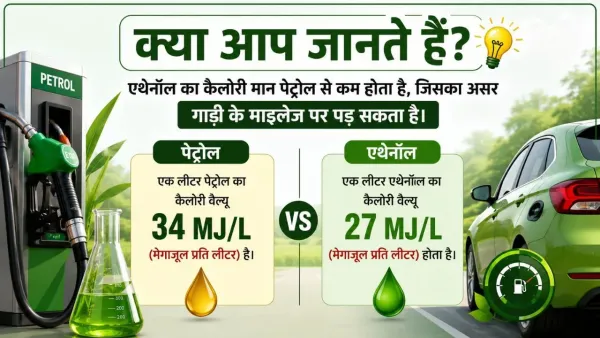
5. Less mileage than petrol
Many customers had complained about reduction in mileage after the shift from E10 to E20. This reduction can range between 5-12 percent, depending on when the car was manufactured. However, the Petroleum Ministry has said that this reduction in mileage will be minor.
What is the calorific value of petrol and ethanol?
Is E100 suitable for all vehicles?
Let us tell you that E100 fuel is not suitable for existing petrol vehicles. The government has made it clear that E100 will be used only in specially developed flex-fuel vehicles. Regular cars designed for E20 fuel will continue to run as before without any changes.
Contact to : xlf550402@gmail.com
Copyright © boyuanhulian 2020 - 2023. All Right Reserved.