Installing a rooftop solar system can significantly reduce electricity bills, but choosing the right type of solar panel is just as important as deciding to go solar. Many homeowners assume that all solar panels perform the same, but that is not the case.
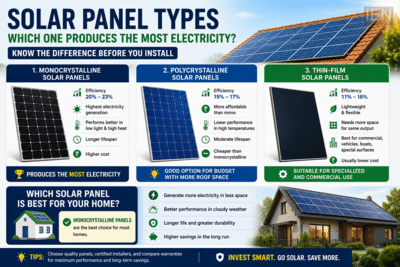
There are three primary types of solar panels available today—Monocrystalline, Polycrystalline, and Thin-Film. Each differs in efficiency, manufacturing process, cost, appearance, and ideal use case.
If you're planning to install a solar power system for your home or business, understanding these differences can help you make a smarter long-term investment.
Monocrystalline Solar Panels: Highest EfficiencyMonocrystalline panels are widely regarded as the most efficient and advanced option currently available for residential installations.
These panels are manufactured using a single, high-purity silicon crystal, giving them their distinctive uniform black appearance.
Key Features-
Efficiency typically ranges from 20% to 23%.
-
Produce more electricity from the same roof area.
-
Perform better in low-light conditions and high temperatures.
-
Require less installation space.
-
Generally have the longest lifespan.
-
Cost more than other panel types.
Although they have a higher upfront price, their superior performance often results in better long-term savings through higher energy generation.
Polycrystalline Solar Panels: Budget-Friendly AlternativePolycrystalline panels are made by melting multiple silicon fragments together, giving them a characteristic blue, crystalline appearance.
For many years they were a popular choice because of their lower cost. However, as manufacturing technology has improved, the price difference between mono and poly panels has narrowed considerably.
Key Features-
Efficiency usually ranges between 15% and 17%.
-
Lower manufacturing cost.
-
Suitable for installations with ample roof space.
-
Slightly lower power output than monocrystalline panels.
-
Performance drops more noticeably in high temperatures.
Many older rooftop solar systems installed before 2020 use polycrystalline panels, but they are gradually being replaced by higher-efficiency technologies.
Thin-Film Solar Panels: Lightweight and FlexibleThin-film panels differ significantly from conventional crystalline panels.
Instead of thick silicon wafers, they use extremely thin layers of photovoltaic material such as cadmium telluride (CdTe) or copper indium gallium selenide (CIGS).
These panels are lightweight, flexible, and much thinner than traditional solar panels.
Key Features-
Efficiency generally ranges from 11% to 16%.
-
Lightweight and flexible.
-
Better suited for curved or weight-sensitive surfaces.
-
Lower electricity production per square meter.
-
Require significantly more installation area to generate the same power.
Thin-film panels are commonly used for commercial buildings, industrial projects, vehicles, boats, and specialized applications rather than standard residential rooftops.
Which Solar Panel Produces the Most Electricity?Among the three technologies, Monocrystalline solar panels generate the highest amount of electricity because they convert a larger percentage of sunlight into usable electrical energy.
Their higher efficiency means homeowners need fewer panels to achieve the same power output, making them particularly suitable for roofs with limited space.
Which Solar Panel Is Best for Homes?For most residential rooftop installations, monocrystalline panels are generally considered the preferred choice.
They offer several important advantages:
-
Higher energy production from limited roof space.
-
Better performance during cloudy weather.
-
Improved efficiency in hot climates.
-
Longer operational lifespan.
-
Faster recovery of installation costs through higher electricity generation.
Although the initial investment may be higher, the increased efficiency often results in better long-term value.
Factors to Consider Before Buying Solar PanelsBefore selecting a solar panel, homeowners should evaluate:
-
Available roof area.
-
Daily electricity consumption.
-
Local weather conditions.
-
Budget.
-
Warranty period.
-
Panel efficiency.
-
Reputation of the manufacturer and installer.
Choosing a certified installer and high-quality components is equally important for maximizing system performance over the life of the installation.
Final TakeawayNot all solar panels are created equal. While Monocrystalline panels deliver the highest efficiency and electricity generation, Polycrystalline panels remain a lower-cost alternative, and Thin-Film panels are designed primarily for specialized commercial applications.
For homeowners looking to maximize energy production, reduce electricity bills, and make a long-term investment, monocrystalline solar panels remain the most efficient and widely recommended option.
Contact to : xlf550402@gmail.com
Copyright © boyuanhulian 2020 - 2023. All Right Reserved.