In 2021, Chau, then 34, of Nghe An Province in central Vietnam, met the 26-year-old while working at a food processing plant in Fukuoka, Japan. She had paid little attention when the new manager stood on the platform introducing himself, vaguely noting only that he had just graduated from university.
But Hikaru was immediately struck by Chau’s eyes among the dozens of workers clad head-to-toe in protective gear. Since they worked in different departments, the two rarely spoke. Chau often heard colleagues whisper that their young manager was struggling financially—he wore the same outfit every day of the week and walked to work, while most people drove cars.
The distance between them vanished when he was reassigned to head Chau’s department.
The lively, open atmosphere and banter among the Vietnamese crew brought them closer. “Back then, I saw him as a younger brother and was even eagerly trying to matchmake him with a younger coworker,” Chau recalls.
He would frequently step in to help Chau. One day, seeing her chatting with a male colleague, he stared at her throughout the shift. Chau noticed it and assumed he was annoyed with her for talking during work hours. But the next day, he walked up to her and asked: “Do you have Line?”
With her limited Japanese, Chau mistook Line, the messaging app, for the factory’s assembly line and hurried back to her workstation. “I thought she didn’t like me and was deliberately evading the question,” Hikaru says.
During the lunch break the next day, he met her in the breakroom and opened the Line app on his phone, and asked to add her as a friend. It was the first time she had seen his face without protective gear.
From that day on, her lunch breaks stretched to half an hour as her sat across from her. Every evening, he would text her until midnight, claiming he had few friends, wanted someone to talk to, and wanted to help teach her Japanese.
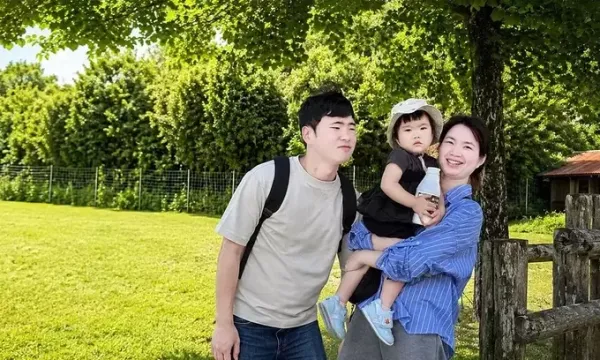
Thai Chau, 35, and Hikaru, 26, in Nobeoka, Miyazaki Prefecture. Photo courtesy of the couple |
One evening, he invited her to a park near her dormitory to confess his love. Taken aback, she asked him: “Do you know how much older I am than you?” Hikaru had guessed she was around 25, three years older than him.
She said: “I’m 30. I’m divorced and have a son back home in Vietnam. I came to Japan as a worker just so my son and I could have a better future.”
The sudden barrage of information caught the 22-year-old off guard, leaving him silent. As they sat in awkward silence, a police patrol car pulled up and officers stepped out to check on them. She panicked, but Hikaru remained unbothered, telling the officers: “I just confessed my love to her, and I’m waiting for her answer.”
After the police left, he looked at her and said: “I’ve thought it through. Age doesn’t matter to me. I just want to know, if we get married, will your son accept it.”
She was touched by his honesty, but was still anxious about building a future with a poor young man.She tossed and turned almost all night, but by morning, she decided to open her heart to Hikaru. Their romance unfolded in secret, marked by occasional spats. Once, after seeing her laughing with a male Vietnamese supervisor who was helping carry goods, he left early and cut off all contact.
Three days later, she went to his apartment to talk. She found him buried under a blanket on his bed. The moment he saw her, he burst into tears, confessing he was jealous but too afraid to say so, fearing she would see him as childish and impulsive. “Give me two years to build my career, and I’ll take care of our future,” he promised her then.
During that visit, she realized he was far from poor. He rented a spacious apartment and had five identical sets of jeans and button-down shirts simply to avoid wasting time choosing outfits every morning. He didn’t own a car because he lived within walking distance of the factory.
Although they had agreed on a two-year timeline, he was still uneasy, and persuaded her to visit his family the following week. Only then did she realize he came from real wealth. His house nestled on a quiet hill in a traditional-style residence, his father was an executive in a conglomerate and his mother ran a real estate company.
Sitting with people from a completely different social class made Chau feel overwhelmed. But after hearing their love story, Hikaru’s mother reassured her: “Don’t worry, dear, I’m five years older than his father.” His father also voiced total confidence in his son’s decision.
A month later, Hikaru received a transfer order. Fearing distance might pull them apart, he proposed marriage. They registered their marriage during the COVID-19 pandemic and skipped a formal ceremony. “I’ll handle our finances—you just focus on having our baby while your health is good,” he promised her.
Thai Chau and Hikaru with their daughter on a trip in 2026. Photo courtesy of the couple |
More than four years have passed, and he has proven his promise was far from empty talk. Now settled in Nobeoka, a city in Miyazaki Prefecture, the couple has a two-year-old daughter named Haru. Despite his demanding job, he rolls up his sleeves the moment he gets home to clean, wash dishes, and play with his daughter. He has turned total control of the family finances over to his wife.
Parents-in-law’s total support
Chau’s mother-in-law constantly tells her not to stress over domestic chores and steps in to help care for the child. Her soft-spoken husband regularly reminds Hikaru to pay more attention to Chau, and occasionally slips her money for personal shopping.
Hikaru recalls a time when the couple had an argument, and he stormed off to his parents’ house. But they scolded him, saying: “You have your parents right next to you, but Chau came here with only her husband and her husband’s family.”They even refused to serve him dinner.”If you walk out, who can she rely on?” They promptly sent him back to his wife, declaring: “From now on, whenever you two fight, she’s the only one allowed to come stay with us.”
The couple is currently doing the paperwork to sponsor Chau’s son from her previous marriage to join them in Japan. “What we want most right now isn’t a lavish wedding,” Chau says. “It’s taking good care of our children and keeping this peaceful life.”
Contact to : xlf550402@gmail.com
Copyright © boyuanhulian 2020 - 2023. All Right Reserved.