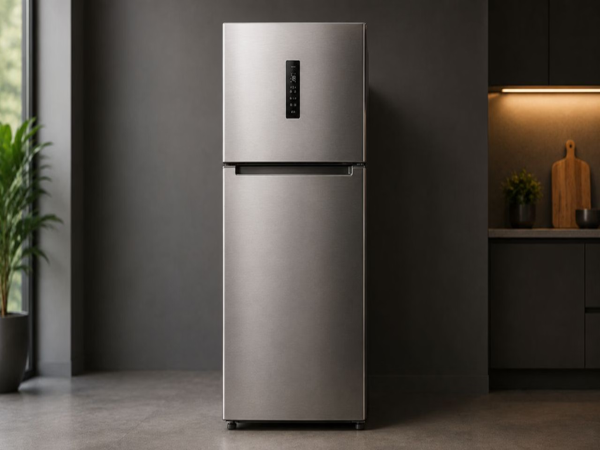
A refrigerator is a household appliance that runs 24 hours a day, so its electricity consumption cannot be overlooked. Inverter refrigerators claim to reduce this consumption, but simply buying one based on the "inverter" label isn't necessarily wise. Here is how an inverter refrigerator differs from a standard one.
Refrigerators are among the household appliances that run continuously, day and night. Yet, when we think about rising electricity bills, our attention usually turns first to air conditioners, air coolers, and water heaters. Recently, the demand for inverter refrigerators has surged in the market. But what exactly is an inverter refrigerator, how does it differ from a standard model, and is it truly effective at saving electricity?
What is an inverter refrigerator?
To understand what an inverter refrigerator is, you first need to know how a standard refrigerator works. The compressor in a standard refrigerator always operates at full capacity (fixed speed). When the internal temperature rises, it kicks in at full power, and once the desired temperature is reached, it shuts off abruptly. This frequent "on-off" cycling consumes a significant amount of electricity.
In contrast, an inverter refrigerator utilizes smart compressor technology. It can adjust its speed—slowing down or speeding up—based on the cooling requirements inside the unit. Instead of shutting down completely when the temperature is right, it continues to run at a very low speed. This not only prevents wasted electricity consumption but also maintains a consistent internal temperature. It functions much like an inverter AC, helping to save energy.
Does an inverter refrigerator save electricity?
Yes, an inverter refrigerator can help reduce electricity consumption, especially when it runs continuously for long periods. The compressor of an inverter refrigerator adjusts its capacity based on demand, thereby minimizing the frequent start-stop cycles typical of standard models.
However, not all inverter refrigerators offer the same level of energy savings. Factors such as capacity, insulation, design, temperature settings, ambient room temperature, and usage patterns all influence electricity consumption.
Why is the BEE Star Rating important?
If you are buying an inverter refrigerator to save electricity, simply purchasing one isn't enough. When buying a new fridge, you should check the Bureau of Energy Efficiency (BEE) star label. These ratings range from 1 to 5 stars; the higher the star rating, the less electricity the refrigerator consumes.
Check the annual electricity consumption
The refrigerator's label also provides information on annual electricity consumption (measured in kWh). For instance, if you are comparing two inverter refrigerators of the same size, always choose the model with the lower annual electricity consumption figure (units) on its BEE label.
Keep these factors in mind when buying a refrigerator
Don't focus solely on capacity or price when purchasing a new refrigerator. Compare the BEE star rating, annual electricity consumption, capacity, insulation, compressor technology, and warranty.
In these times of rising costs and energy crises, purchasing an inverter refrigerator is considered a smart investment. Although the initial cost may be slightly higher than that of a standard refrigerator, the long-term savings on electricity bills easily offset this additional expense.
Disclaimer: This content has been sourced and edited from Amar Ujala. While we have made modifications for clarity and presentation, the original content belongs to its respective authors and website. We do not claim ownership of the content.
Contact to : xlf550402@gmail.com
Copyright © boyuanhulian 2020 - 2023. All Right Reserved.